“If you’re against the unethical treatment of hens, why not just eat free-range? They’re totally happy!”
The above statement is something I hear a lot, and it isn’t hard to understand why this is such a common assumption throughout society. Free-range eggs are shown alongside images of hens being free from cages, roaming fields, in essence – being completely free from cruelty. Yet sadly this is often far from reality.
Whilst free-range may mean hens are ‘cage-free’ they are not in any essence ‘free’. It’s a nice fairy-tale to believe, that the billions of eggs we consume each year are produced by hens which have endured no unethical treatment, and I wish it were true! But in reality, the term ‘free-range’ can be seen as a greenscreen for the egg industry. Legally, in the UK, there must be no more than 9 hens per square metre. Now picture a square metre, and picture 9 hens – the hen-to-floor space ratio doesn’t quite add up right?
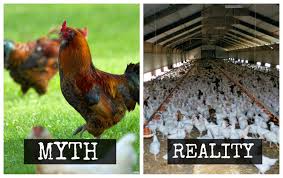
As shown by the picture above, the difference between the myth and reality can be quite shocking. But I would like to point out that the free-roaming picture on the left is not a total myth – just an exaggeration of the truth. Free-range hens are legally required to have continuous access to outdoor areas during their egg-laying cycle. The requirements state that there must be one hectare of outdoor range for every 2,500 hens. Broken down, that is 4 square metres per hen. Not bad compared to the indoor figures, right? Whilst it is an improvement on previous methods of battery farming, studies have still shed issues on the ability of hens to roam outdoors. For example, many have drawn on the fact that as populations inside the hen-house increase, the likelihood of a hen finding a pop-hole, and getting past others to it, decreases. More-so, there is the common issue of regulation.
If the lack of freedom in ‘free-range’ weren’t enough, there are the further issues of debeaking and male culling. Beak-trimming is a process of removing parts of the hen’s bottom and top beak. It is most commonly done at a day old. It has been hotly argued as to the level of pain debeaking causes, yet scientific studies have concluded that debeaking leads to not only pain during the procedure, but chronic pain following.

Advocates for debeaking state that it is to help the hens, to prevent damage caused through injurious pecking, which can ultimately lead to mortality. In the stressful environment the hens are placed in, pecking is much more likely. If only there were another solution, say, provide more space?!
As for the males, chick culling is common practice to dispose of male embryos, those of which have no use on the farm. The concept of buying free-range is a nice idea, and I am not denying that it is a step up from previous battery farmed methods. More-so, it is important to stress that each farm is different. I therefore suggest that if you are not planning on giving up eggs, to research where yours are coming from, and if the ‘free-range’ labelling appears true.
 VeganForever